Agentic AI vs Traditional AI: What's the Difference?
Every AI system is now being marketed as "intelligent," "autonomous," or "next-generation." That makes it hard to tell what's actually different between the tools. Agentic AI vs traditional AI is not a matter of one being newer or better. They solve different problems. Traditional AI is built to respond. Agentic AI is built to act. This guide breaks down the real technical and practical differences, where AI agents and generative AI fit into the picture, and how to know which approach your business actually needs.
Agentic AI vs Traditional AI: What's the Difference?
Every AI system is now being marketed as "intelligent," "autonomous," or "next-generation." That makes it hard to tell what's actually different between the tools. Agentic AI vs traditional AI is not a matter of one being newer or better. They solve different problems. Traditional AI is built to respond. Agentic AI is built to act.
This guide breaks down the real technical and practical differences, where AI agents and generative AI fit into the picture, and how to know which approach your business actually needs.
What Is Traditional AI?
Traditional AI includes the systems most businesses have used for years - predictive models, rule-based automation, chatbots, and recommendation engines.
Traditional AI is defined by:
• Responding to a single input at a time
• Following fixed logic or trained patterns
• Requiring a human to initiate every action
• Producing an output, then stopping
• No independent decision-making beyond its trained scope
A traditional AI chatbot can answer a question. It cannot decide to check your order history, issue a refund, and follow up by email - unless a person tells it to do each of those things separately.
What Is Agentic AI?
Agentic AI refers to AI systems built to pursue a goal, not just respond to a prompt. Given an objective, an agentic AI system plans the steps needed, decides which tools or data it requires, takes action, checks the outcome, and adjusts if the result isn't right.
This is the core of the agentic AI solutions approach businesses are adopting in 2026 - AI that completes a workflow end-to-end rather than answering one question at a time.
Core characteristics include:
• Goal-oriented planning
• Autonomous decision-making
• Multi-step task execution
• Tool and system integration
• Memory across a task or session
• Self-correction when an action doesn't produce the expected result
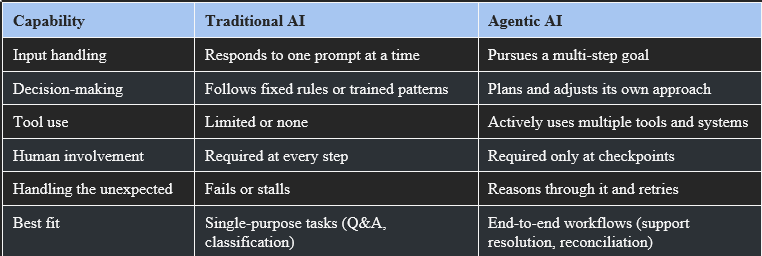
Agentic AI vs Traditional AI: Key Differences
The clearest way to see the difference is side by side:
Where AI Agents Fit In
AI agents are the working components of agentic AI. A single agent typically handles one defined responsibility -reading a support ticket, checking inventory, scheduling a meeting.
Agentic AI systems usually combine several AI agents together, each specialized, coordinating to complete a larger process. This is why "agentic AI" and "AI agents" are often used interchangeably, even though an AI agent is really one part of a broader agentic system.
Generative AI vs Agentic AI
Generative AI creates content - text, images, code, summaries - in response to a prompt. It is reactive by design.
Agentic AI can use generative AI as one tool among several. For example, an agentic AI system resolving a customer complaint might use generative AI to draft the reply, while also independently checking the order database, verifying refund eligibility, and updating the CRM - none of which generative AI does on its own.
Generative AI answers "what should this say?" Agentic AI answers "what needs to happen, and how do I make it happen?"
Intelligent Automation vs Agentic AI
Intelligent automation (often built on RPA plus AI) automates a defined process according to set rules, with some ability to handle minor variations.
Agentic AI goes further. Where intelligent automation follows a scripted path with limited flexibility, agentic AI reasons through unexpected situations and can change its approach mid-task.
Intelligent automation is faster to deploy for stable, repetitive processes. Agentic AI is better suited to processes involving judgment, exceptions, or multiple interacting systems.
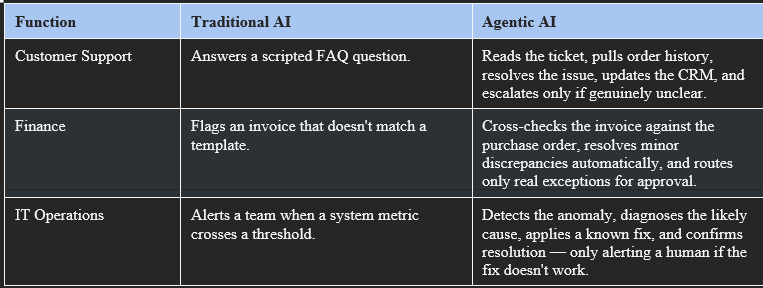
Real-World Examples
When to Use Traditional AI vs Agentic AI
Traditional AI is the right fit when:
• The task is narrow and repeatable (classification, single-question answering)
• Speed of deployment matters more than flexibility
• The process rarely changes
Agentic AI is the right fit when:
• The task spans multiple steps and systems
• Outcomes vary and require judgment
• The process currently depends on a person manually connecting different tools
Most businesses need both. Agentic AI does not replace every traditional AI use case - it extends what's possible for the workflows traditional AI was never built to handle.
Why Choose Venus Global Tech for Agentic AI Solutions
Deciding between traditional AI, intelligent automation, and agentic AI depends on the specific workflow, the systems involved, and the outcome you're trying to achieve.
At Venus Global Tech, we help organizations assess which approach fits each business process, then design and deploy the right solution - whether that's a targeted automation, a generative AI integration, or a full agentic AI workflow.
Our expertise includes:
• AI capability assessment and strategy
• Custom AI agent development
• Enterprise AI automation
• Generative AI integration
• Intelligent process automation
• Cloud-native AI deployment
Not Sure Which AI Approach Your Business Needs?
Choosing between traditional AI, intelligent automation, and agentic AI shouldn't be a guess. Venus Global Tech can assess your workflows and recommend the right fit - not the most complex option, the right one.
Contact our AI experts today to get a clear, honest evaluation of where agentic AI can create real value for your business.
Conclusion
Agentic AI vs traditional AI isn't a competition - it's a difference in autonomy. Traditional AI responds. Generative AI creates. Intelligent automation follows rules. Agentic AI plans, decides, and acts across an entire workflow.
Businesses that understand these distinctions can apply the right type of AI to the right problem, instead of assuming one approach fits every use case. As agentic AI adoption grows in 2026, the organizations getting real results are the ones matching the technology to the task - not chasing the newest label.
Determine whether your business needs predictive analytics, robotic automation, or autonomous reasoning agents. Consult with our specialists through Venus Global Tech's Enterprise Agentic AI Consulting.
Frequently Asked Questions
1. What is the main difference between agentic AI and traditional AI?
Traditional AI responds to a single prompt and stops. Agentic AI pursues a goal across multiple steps, making decisions and taking action without needing a new prompt at every stage.
2. Is agentic AI the same as AI agents?
Not exactly. An AI agent is one component that handles a specific task. Agentic AI usually refers to a system made up of multiple AI agents working together toward a larger goal.
3. Is generative AI a type of agentic AI?
No. Generative AI creates content in response to a prompt. Agentic AI can use generative AI as one tool within a broader, self-directed workflow, but the two are not the same thing.
4. How is agentic AI different from intelligent automation?
Intelligent automation follows defined rules with limited flexibility. Agentic AI can reason through unexpected situations and adjust its approach, making it better suited to processes with exceptions or judgment calls.
5. Does agentic AI replace traditional AI?
No. Traditional AI remains the better fit for narrow, repeatable tasks. Agentic AI is designed for multi-step workflows that traditional AI was never built to handle - most businesses use both.