AI-Powered ERP: How Artificial Intelligence Is Transforming Modern Business Operations
Organizations deploying AI-powered ERP platforms report 25-45% faster operational decision-making and up to 30% reduction in workflow bottlenecks, documented in McKinsey & Company Research on GenAI and Operations . In 2026, enterprise systems are evolving from passive transaction ledgers into proactive systems of intelligence that forecast inventory anomalies, automate reconciliations, and resolve supplier discrepancies in real time.
Traditional ERP systems have always promised efficiency, but for years they delivered it through rigid rules and after the fact reporting. That's changing fast, AI-powered ERP solutions are moving businesses from systems that simply record what happened to systems that anticipate what's likely to happen next, flag risks before they become problems and handle exceptions without waiting for a person to notice them.
This guide breaks down how AI is actually transforming ERP in 2026, what capabilities are genuinely useful versus hype, and what to look for whether you're upgrading an existing system or evaluating AI ERP software development services for a custom build.
What Is AI-Powered ERP?
AI-powered ERP refers to enterprise resource planning systems that embed machine learning, natural language processing, and predictive analytics directly into core business workflows not as a separate reporting layer, but as an active part of how the system operates day to day.
The distinction matters: a traditional ERP stores and processes business data. An AI-powered ERP helps users understand that data, search it faster, reduce repetitive manual work and take action with better context, often before a human would have noticed the pattern at all.
How AI Is Actually Changing ERP Workflows
The shift in 2026 is best understood through what's actually happening inside the workflow, not marketing language:
- Automated transaction classification reduces manual data entry and improves accuracy across finance and procurement, without requiring a person to categorize every line item
- Predictive workflow routing approvals and reviews get directed based on historical risk patterns instead of fixed, rigid thresholds
- Intelligent exception handling anomalies get explained in plain language, helping teams resolve issues faster instead of digging through raw data to figure out what went wrong
- Continuous process optimization the system identifies slowdowns and suggests adjustments without requiring a full system redesign
Together, these changes mark a shift from process automation (following fixed rules faster) to process intelligence (understanding context and adapting over time), which is the real distinction between a traditional ERP and a genuinely AI-powered one.
Where AI-Powered ERP Delivers the Most Value
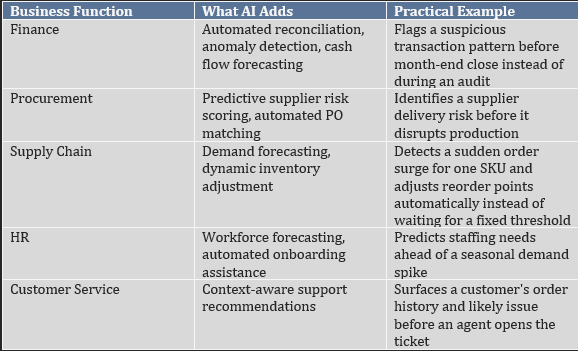
How Major ERP Vendors Are Approaching AI in 2026
- SAP - Joule, an enterprise AI assistant with copilot and agent capabilities embedded across finance, procurement, supply chain and HR. plus predictive analytics built into workflows like order fulfillment and cash flow forecasting
- Oracle - positioning AI as workflow-native assistance rather than a bolt-on analytics product, with process native agents automating complex finance and supply chain workflows inside Fusion applications
- Microsoft - Copilot for Dynamics 365, offering natural language and context-aware assistance inside finance, operations, sales and customer service, tied directly to the underlying business data model
- Odoo - a more accessible entry point, with its "Ask AI" feature allowing users to interact with the system in natural language, well suited to small and growing businesses not ready for enterprise-scale AI ERP
The common thread across all of them: AI is no longer sold as a separate premium feature. It's being built directly into the core platform.
What to Look for in AI ERP Software Development Services
Not every AI ERP claim delivers real value. Before committing to a platform or a custom build, evaluate:
- Whether AI is embedded in workflows or just bolted onto reporting the real value is in day-to-day decision support, not a dashboard that looks impressive but doesn't change how work gets done
- Data governance and explainability as AI starts automating financial and operational actions, being able to explain why a decision was made matters enormously for auditors and compliance teams
- Clean data as a prerequisite, not an afterthought - AI ERP works best with clean data, proper permissions, trained users, and clear workflows already in place; layering AI onto messy data amplifies problems rather than solving them
- Clear, practical use cases over hype-driven scope - Gartner has specifically flagged that many agentic AI projects fail when business value is unclear or implementation is driven by excitement rather than a defined problem
5. Integration depth with existing systems - since most businesses are adopting ERP as a platform that connects with best of breed AI tools, not a single monolithic suite anymore
Common Mistakes When Adopting AI-Powered ERP
1. Adding AI features before fixing data quality - AI amplifies whatever data discipline (or lack of it) already exists in the system
2. Treating AI as a replacement for process planning - AI agents can support business teams, but they shouldn't replace proper decision-making structures and management oversight
3. Chasing every available AI feature instead of solving a specific, measurable business problem first
4. Underestimating governance needs - as AI starts taking automated actions, not just generating reports, the need for audit trails and explain ability increases significantly
Why Choose Venus Global Tech for AI-Powered ERP Solutions
Bringing genuine AI capability into an ERP system takes more than turning on a vendor's built-in copilot it requires clean data, the right integration approach, and a clear understanding of which workflows actually benefit from AI versus which ones just need better process design.
Our ERP and AI solutions combine ERP consulting, implementation and AI ERP software development services, so businesses get intelligent automation built around their actual operations, not a generic AI layer forced onto a system that wasn't ready for it.
We work with businesses to assess data readiness, identify the highest-value automation opportunities and implement AI capabilities that are explainable and auditable, not black-box decisions nobody can account for later. You can see our full range of enterprise technology work at Venus Global Tech.
Ready to Bring AI Into Your ERP System? Let's Talk
Given how much AI ERP capability now varies by vendor and use case, the right approach depends entirely on your current systems, data readiness, and which workflows would actually benefit most from automation not a generic feature checklist.
Conclusion
AI-powered ERP in 2026 represents a real shift, not just a marketing refresh from systems that record what happened to systems that anticipate what's coming and explain their reasoning along the way. The businesses seeing the strongest results (25-45% faster decisions (as validated by McKinsey & Company Research on GenAI and Operations), up to 30% lower operational costs) are the ones treating AI as an intelligence layer built on clean data and clear use cases, not a feature checklist bolted onto an unprepared system.
Experience next-generation intelligent operations with the Venus ERP Platform, or consult our enterprise engineering team through our ERP AI Implementation & Modernization Services to embed predictive agents into your existing SAP, Oracle, or custom ERP ecosystem.
Frequently Asked Questions
What is AI-powered ERP and how is it different from traditional ERP?
Traditional ERP stores and processes business data using fixed rules. AI-powered ERP embeds machine learning and predictive analytics directly into workflows, helping the system understand context, predict outcomes, and recommend actions rather than just recording transactions and generating reports after the fact.
What are the real benefits of AI in ERP systems?
According to research by McKinsey & Company Research on GenAI and Operations, organizations deploying intelligent ERP systems achieve 25-45% faster operational decision-making and up to 30% lower process costs. These gains stem from predictive workflow routing, automated anomaly detection, and rapid exception triage. See how our ERP AI Implementation & Modernization Services can accelerate your systems.
Which ERP vendors offer the strongest AI capabilities in 2026?
SAP (Joule), Oracle (Fusion AI agents), Microsoft (Copilot for Dynamics 365) and Odoo (Ask AI) all offer embedded AI capabilities, though the right fit depends on business size, complexity, and existing systems rather than any single vendor being universally "best."
Does AI-powered ERP replace the need for good data management?
No, AI ERP capabilities work best with clean data, proper permissions, trained users and well-defined workflows already in place. Poor data quality gets amplified, not fixed, by adding AI on top of it.
Can small and mid-sized businesses use AI-powered ERP, or is it only for large enterprises?
Small and mid-sized businesses can absolutely use AI-powered ERP platforms like Odoo are specifically designed to be accessible for smaller, growing businesses, while larger enterprise platforms like SAP and Oracle serve more complex, large-scale operations.