ESG Reporting Explained: A Practical Guide for Manufacturing Companies
ESG reporting is transitioning from voluntary corporate marketing into mandatory regulatory compliance. From the EU's European Commission CSRD Regulatory Framework to California's California Air Resources Board (CARB Climate Corporate Data Accountability Act - SB 253) , manufacturing enterprises face rigorous Scope 1-3 audit thresholds. Here is how industrial manufacturers build audit-ready carbon accounting, comply with CSRD and GRI standards, and integrate sustainability intelligence into daily operations.
If you run or manage compliance for a manufacturing company, you've likely noticed ESG reporting requests coming from more directions than just regulators customers auditing your supply chain, lenders reviewing your risk profile, and investors asking for climate disclosures that didn't exist five years ago.
This guide breaks down what ESG reporting actually means for manufacturers in 2026, which regulations genuinely apply to you, what a report needs to include and how to build a reporting process that doesn't consume your team's entire year.
What Is ESG Reporting?
ESG reporting is the practice of disclosing a company's performance across three areas: Environmental (emissions, energy use, waste water), Social (labor practices, worker safety, community impact), and Governance (board oversight, ethics, data security).
For manufacturers specifically, environmental disclosures tend to carry the most regulatory weight, since the sector is a significant generator of industrial emissions and waste but social metrics like worker safety and governance metrics like supply chain oversight are increasingly scrutinized too, particularly for companies with global supply chains.
Why Manufacturing Companies Face Unique ESG Pressure
Manufacturing sits under more direct ESG scrutiny than most other sectors, for a few concrete reasons:
● Resource intensity - manufacturing consumes significant energy and raw materials, making emissions and resource-use disclosures a natural regulatory focus
● Supply chain complexity - multi-tier supplier networks make Scope 3 emissions (indirect emissions from suppliers and logistics) especially difficult to track and report accurately
● Physical footprint - factories, warehouses and industrial sites are easier for regulators and auditors to inspect and verify than say a software company's claims
● Circular economy expectations - stakeholders increasingly expect manufacturers to show progress on waste reduction and material reuse, not just emissions numbers.
Key ESG Regulations Manufacturers Must Know in 2026
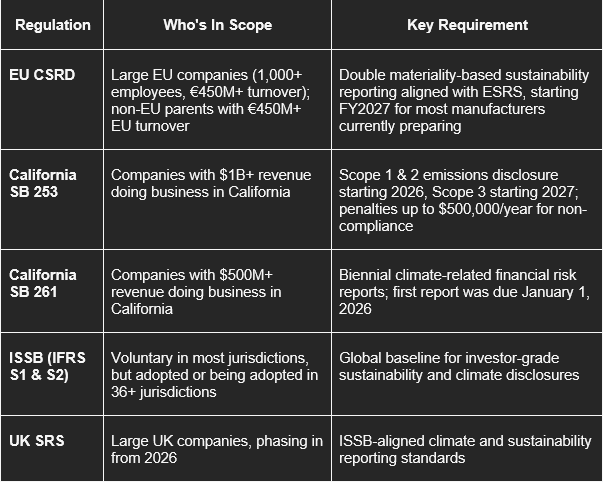
A critical point for manufacturers: even if your company falls outside mandatory thresholds after the CSRD Omnibus changes, if you're a supplier to a company that IS in scope, you'll likely still be asked to provide ESG data as part of their supply chain reporting obligations.
What to Include in a Manufacturing ESG Report
A credible ESG report for a manufacturing company typically covers:
Environmental
● Scope 1, 2, and (where applicable) Scope 3 greenhouse gas emissions
● Energy consumption and renewable energy usage
● Water usage and waste management practices
● Circular economy initiatives (material reuse, recycling rates)
Social
● Worker safety incident rates and health programs
● Labor practices across owned facilities and key suppliers
● Community engagement and local economic impact
Governance
● Board-level oversight of ESG risks and strategy
● Supply chain due diligence processes
● Data security and ethics policies
● Executive accountability for sustainability targets
Common ESG Reporting Challenges for Manufacturers
● Data fragmentation - emissions and resource-use data often live in disconnected plant level systems that were never built for consolidated reporting
● Scope 3 complexity - indirect supply chain emissions are consistently the hardest data category to collect accurately, and most companies need supplier engagement before this data is investor-grade
● Assurance requirements - CSRD requires third-party limited assurance from the first reporting year, which means your data needs to be audit-ready, not just internally consistent
● Multi-jurisdiction overlap - a manufacturer selling into the EU, California and the UK simultaneously may need to satisfy several overlapping-but-different frameworks at once
● Keeping pace with regulatory change - the CSRD Omnibus simplification alone shifted thresholds, timelines, and required data points significantly in a single year and manufacturers building a reporting process need it flexible enough to absorb further changes
Step-by-Step: How to Start ESG Reporting as a Manufacturer
- Determine your actual regulatory scope - check revenue, employee count, and jurisdictions against CSRD, California SB253/261, and any customer-driven requirements
Run a materiality assessment - identify which ESG topics are financially material to your business and which reflect your operational impact (this is the "double materiality" approach central to CSRD) - Map your current data sources - inventory what emissions, energy, and workforce data you already collect and where the gaps are
- Choose your framework(s) - align with ESRS if CSRD applies, ISSB if investor-facing or GRI if stakeholder facing many manufacturers end up reporting against more than one
- Build data collection systems before the reporting deadline - start 12-18 months ahead of your first mandatory reporting period, especially if Scope 3 data collection is new to your organization
- Prepare for assurance - engage a third party for limited assurance if required and keep documentation audit-ready from day one rather than reconstructing it after the fact
Why Choose Venus Global Tech for ESG Reporting Services
Building a manufacturing ESG reporting process from scratch is a data and systems challenge as much as a compliance one which is exactly where a lot of manufacturers get stuck.
Venus Global Tech works with manufacturers to build the data infrastructure and reporting processes that make ESG compliance manageable rather than a yearly scramble. Our ESG reporting services cover materiality assessment, data pipeline integration across plant-level systems, and framework-aligned report preparation for CSRD, ISSB and California-specific requirements.
Beyond ESG specifically, our broader work in enterprise data and systems integration means we're often able to connect ESG data collection directly into a manufacturer's existing operational systems, rather than building yet another disconnected reporting tool. You can see more about our full range of services at Venus Global Tech.
Not Sure Which ESG Regulations Apply to Your Manufacturing Business?
Given how much the regulatory landscape shifted in the past year alone, it's worth getting a clear, current answer rather than working off outdated assumptions. If you'd like a straightforward assessment of your actual reporting obligations and what a realistic ESG reporting timeline looks like for your business, get in touch with our team to get started.
Conclusion
ESG reporting for manufacturers in 2026 is less about doing the maximum and more about doing the right things accurately knowing your actual regulatory scope, building data systems that hold up to assurance, and treating supply chain disclosure as an ongoing process rather than a once a year fire drill. Manufacturers that build this capability now, even ahead of a hard deadline, are the ones who'll handle both regulatory requirements and customer ESG requests without it becoming a recurring crisis.
Looking to automate your Scope 1, 2, and 3 emissions accounting and generate investor-ready sustainability disclosures? Discover Venus Global Tech's Enterprise ESG Advisory & Sustainability Solutions to streamline compliance across CSRD, GRI, SASB, and SEC standards.
Frequently Asked Questions
Does my manufacturing company need to do ESG reporting?
It depends on your revenue, employee count, and where you do business. After the CSRD Omnibus changes outlined by the European Commission CSRD Regulatory Framework, EU mandatory thresholds now sit at 1,000+ employees and €450 million+ turnover. In the US, California's SB 253 and SB 261 apply to companies with $1B+ and $500M+ revenue respectively doing business in the state. Even outside these thresholds, many manufacturers face ESG data requests from customers and lenders.
What is the difference between ESG reporting and ESG compliance?
ESG reporting is the act of disclosing your sustainability, social, and governance performance. ESG compliance specifically refers to meeting mandatory legal requirements set by regulators. You can report voluntarily without being legally required to, but if you're in scope for CSRD, SB253, or similar regulations, reporting becomes a compliance obligation with real penalties for non-compliance.
What is Scope 1, 2, and 3 emissions reporting?
Scope 1 covers direct emissions from owned operations (like factory equipment). Scope 2 covers indirect emissions from purchased energy (like electricity). Scope 3 covers all other indirect emissions across your value chain, including suppliers and logistics this is consistently the hardest category for manufacturers to measure accurately.
How long does it take to become ESG reporting-ready?
Most companies preparing for their first mandatory reporting cycle need 12-18 months to set materiality boundaries, build data collection pipelines, and complete an assurance readiness cycle. Scope 3 data collection specifically often requires supplier engagement that adds time to the first reporting cycle.
What happens if a manufacturing company doesn't comply with ESG reporting requirements?
Penalties vary by regulation California's SB 253 carries administrative penalties of up to $500,000 per year for non-compliance under California Health and Safety Code § 38532 (SB 253). Beyond direct fines, non-compliance can also mean loss of investor confidence, exclusion from supply chains that require ESG disclosure from vendors, and reputational risk with customers.