The Complete Guide to Enterprise Resource Planning (ERP) in 2026
The global ERP software market is projected to reach $106.22 billion in 2026, advancing at roughly 13% CAGR according to Fortune Business Insights & Grand View Research ERP Industry Reports , with cloud and hybrid deployments accounting for over 70% of implementations. Yet mid-market deployments still struggle with cost overruns when legacy processes remain unoptimized. This complete guide breaks down modern ERP architecture, AI workflow agents, total cost of ownership models, and step-by-step rollout roadmaps.
Enterprise Resource Planning has quietly become one of the largest software categories in the world, and 2026 is shaping up to be a pivotal year for it not because ERP itself is new, but because AI-driven automation, cloud-first deployment, and mid-market adoption are reshaping what a "modern ERP" actually looks like.
This guide covers everything a business needs to understand before evaluating ERP software solutions, what ERP actually does the core modules that matter, how deployment models differ, what real implementation costs look like, and how to avoid the mistakes that cause most ERP projects to run over budget or miss their launch date.
What Is Enterprise Resource Planning (ERP)?
Enterprise Resource Planning (ERP) is a category of software that integrates and centralizes core business functions finance, inventory, procurement, HR, sales and manufacturing into a single connected system, rather than managing each function through separate, disconnected tools.
The core value isn't any single feature; it's the fact that data entered once (a sale, a purchase order, a new hire) flows automatically to every department that needs it, instead of being manually re-entered into five different spreadsheets or standalone applications.
Why ERP Matters More in 2026 Than Ever
A few forces are converging to make ERP adoption more urgent, not less, this year:
- AI-enabled analytics are now standard, not a premium add-on ERP platforms with embedded intelligence features have enabled companies to achieve a 35% improvement in decision-making speed
- Cloud has become the default deployment model, with cloud ERP adoption reaching roughly 70% of implementations, up sharply from just a few years ago
- Mid-market adoption is accelerating fastest small and mid-market ERP is growing at roughly 19% CAGR, outpacing large enterprise growth, as SaaS pricing models make ERP financially realistic for smaller businesses for the first time
- Automation integration (RPA + ERP) is delivering measurable results a 30% increase in efficiency for rule-based tasks and a 25% reduction in manual errors where the two are combined
Core ERP Modules Every Business Should Understand
Not every business needs every module, but these are the most widely adopted, in order of prevalence:
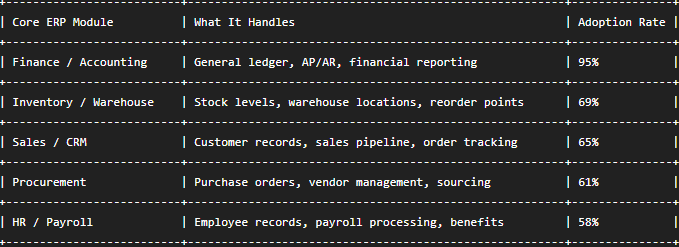
Finance is effectively universal across ERP implementations; it's the module nearly every business needs regardless of industry, which is why it's almost always the starting point for a phased rollout.
ERP Deployment Models: Cloud vs. On-Premise vs. Hybrid
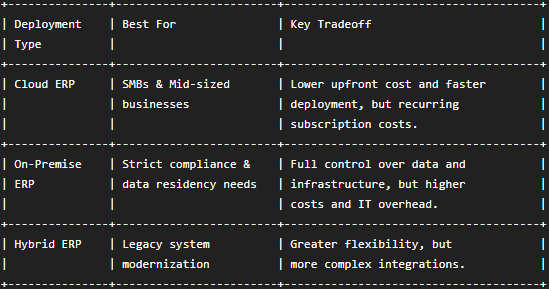
Cloud has become the clear default current data shows cloud deployments account for over 70% of ERP implementations, with hybrid models actually growing at the fastest rate (15.48% CAGR) as businesses migrate in stages rather than all at once.
Off-the-Shelf ERP vs. a Custom ERP Development Company
This is one of the most consequential decisions in any ERP project:
Off-the-shelf ERP software solutions (SAP, Oracle, Microsoft Dynamics, NetSuite, Odoo) offer faster deployment, established support ecosystems, and lower initial cost well-suited to businesses whose processes align reasonably well with standard industry workflows.
Working with an ERP development company for a custom or heavily customized build makes sense when your operations don't fit a standard mold specialized manufacturing processes, unique compliance requirements, or workflows that would otherwise require expensive, fragile customization layered onto an off-the-shelf product. The right choice isn't about which is "better" in the abstract it's about how far your actual business processes deviate from what standard ERP software solutions assume.
ERP Implementation: What to Realistically Expect
- Timeline: SMBs typically complete ERP projects in 3-9 months; larger enterprises take 6-18 months, with an industry average around 17 months for mid-size companies
- Approach: according to the Panorama Consulting Solutions ERP Benchmark Report, 58.5% of companies use a phased rollout (module by module), 20.8% use a "big bang" full cutover, and 20.8% use a hybrid approach phased implementations consistently show fewer overruns
- Go-live reality: 49% of companies go live on schedule, 27% experience slight delays, and 11% miss their scheduled go-live date entirely
- Cost: average implementation cost for a mid-size company runs around $7.1 million, though small and mid-market implementations cost dramatically less depending on scope and whether it's off-the-shelf or custom-built
The Top Causes of ERP Project Overruns
Understanding why ERP projects go over budget is often more useful than any generic "best practices" list:
- Understaffing the project (38% of overruns) treating ERP implementation as a side project for existing staff rather than properly resourcing it
- Scope expansion mid-project (35% of overruns) adding modules or requirements after the project has already started
- Technical and data issues (34% of overruns) poor data quality or unexpected integration complexity discovered mid-implementation
Notably, all three of the top causes are planning and process failures, not technology limitations reinforcing that ERP success depends heavily on how the project is managed, not just which platform is chosen.
How to Choose the Right ERP Software Solution
- Map your actual core processes before evaluating any vendor know which modules (finance, inventory, HR, etc.) are truly non-negotiable
- Decide between off-the-shelf and custom early this shapes budget, timeline, and vendor selection from the start
- Prioritize data readiness since data and technical issues cause more overruns than any other single factor
- Choose a phased rollout unless there's a specific reason for a full cutover the data consistently favors phased approaches
- Budget realistically for staffing, not just software licensing understaffing is the single largest cause of budget overruns
- Plan for AI and automation capability from the start, even if you don't need it on day one retrofitting intelligence features later is more disruptive than building for it upfront
Why Choose Venus Global Tech for Your ERP Journey
Choosing between off-the-shelf ERP software solutions and a fully custom build depends entirely on how your business actually operates and getting that decision wrong early is one of the most expensive mistakes a company can make in this process. Our ERP and AI solutions combine traditional ERP consulting and implementation with AI-driven automation and analytics, so businesses aren't stuck choosing between a standard system and one that actually leverages the intelligence features reshaping the market this year.
We work with businesses across ERP consulting, implementation, and full custom development, helping you avoid the staffing, scope and data pitfalls that account for the vast majority of ERP budget overruns. You can see our full range of enterprise technology work at Venus Global Tech.
Evaluating ERP for Your Business? Start With a Clear Assessment
Given that understaffing and scope changes cause the majority of ERP project overruns, getting your planning right before implementation begins matters more than which vendor you eventually choose. Reach out to our team for an honest assessment of what ERP approach off-the-shelf, custom or hybrid actually fits your business.
Conclusion
Enterprise Resource Planning in 2026 isn't just bigger it's more accessible, more AI-integrated and more consequential to get right than it was even a few years ago. With the market growing at roughly 13% annually and mid-market adoption accelerating faster than enterprise adoption, more businesses than ever are facing this decision for the first time. The organizations that succeed are the ones that plan realistically around staffing, data readiness and scope discipline, not just the ones that pick the most well-known vendor.
Evaluating modern, AI-native ERP solutions designed for agility without exorbitant enterprise overhead? Explore the Venus ERP Intelligent Suite or speak with our implementation specialists via our Venus ERP AI Implementation Consulting to calculate your migration ROI.
Frequently Asked Questions
What is Enterprise Resource Planning (ERP) in simple terms?
ERP is software that connects core business functions finance, inventory, HR, sales, and procurement into one system, so information entered in one department automatically flows to every other department that needs it, instead of being manually re-entered across disconnected tools.
How much does ERP implementation cost?
Costs vary widely by business size and scope. The average implementation for a mid-size company runs around $7.1 million according to the Panorama Consulting Solutions ERP Benchmark Report, but small and mid-market businesses typically spend significantly less, especially with cloud-based or off-the-shelf ERP software solutions rather than a fully custom build.
How long does ERP implementation take?
Small and mid-sized businesses typically complete ERP projects in 3-9 months, while larger enterprises take 6-18 months, with an industry average around 17 months for mid-size companies specifically.
Should I choose cloud, on-premise, or hybrid ERP?
Cloud ERP is the default choice for most businesses today, accounting for over 70% of new implementations, due to lower upfront cost and faster deployment. On-premise remains relevant for businesses with strict data residency requirements, while hybrid models suit companies transitioning gradually from legacy systems.
What's the difference between off-the-shelf ERP and working with an ERP development company?
Off-the-shelf ERP software solutions deploy faster and cost less upfront but require your processes to fit their standard workflows. An ERP development company builds or heavily customizes a system around your specific operations, which costs more but avoids the fragile customization layers that off-the-shelf products often require for non-standard businesses.